
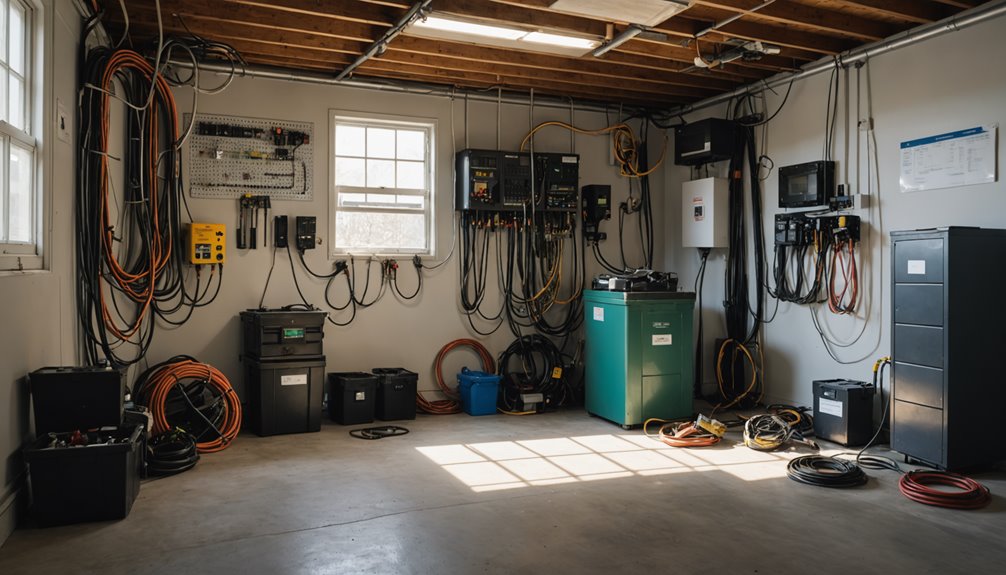
The advertised price for a home battery storage system typically reflects only the base unit cost.
Additional expenses frequently arise during the installation and setup process, and these can substantially increase the total investment. Common costs that are not always included in initial quotes include electrical panel upgrades, permits and inspections, labor, and system monitoring fees.
Understanding these expenses before committing to a purchase allows homeowners to make more accurate financial comparisons and avoid unexpected charges.
What Does Home Battery Storage Actually Cost?
Home battery storage systems typically cost between $12,000 and $20,000 for a complete installation, translating to approximately $1,000 to $1,600 per usable kilowatt-hour. Battery hardware accounts for 33% to 50% of total system costs, with installation labor representing an additional $1,500 to $2,000. Inverters and gateway equipment contribute another $1,500 to $2,500 to the overall expense. Ongoing maintenance costs average $150 to $300 annually and should be factored into long-term budget planning. For homeowners who pair battery storage with a solar installation, the Residential Clean Energy Credit provides a 30% reduction on total eligible costs, which can meaningfully offset the initial investment. When batteries are integrated with rooftop solar panels, surplus energy generated during peak sunlight hours can be stored for later use rather than sent back to the electrical grid.
Why Battery Hardware Is Only Half Your Installed Cost
The total installed cost of a home battery system typically ranges from $12,000 to $20,000, with the battery hardware itself representing only 33% to 50% of that figure. The remaining costs are distributed across several components: labor ($1,500–$2,000), inverters and gateways ($1,500–$2,500), panel upgrades ($1,500–$3,000), and permitting fees ($300–$500). Beyond the initial installation, owners should account for annual maintenance costs of $150–$300. A clear understanding of this cost breakdown allows for more accurate budgeting and reduces the likelihood of unexpected expenses after purchase.
Electrical Upgrades That Quietly Inflate Your Quote
Most homes were not designed to accommodate battery storage systems, which means electrical upgrades are frequently necessary and can add $1,500 to $3,000 to the total installation cost. These upgrades commonly include critical loads subpanels or service panel replacements, both of which increase labor and material costs before the system delivers any backup power capacity.
Additional cost factors include extended conduit runs and fire-code compliance adjustments, which expand the overall project scope. Permitting fees typically range from $300 to $500 depending on local jurisdiction requirements. Required system components such as gateways and inverters are also necessary for legal grid interconnection and contribute further to the total expense.
Accounting for these electrical requirements during the budgeting phase allows homeowners to develop a more accurate cost estimate for a fully operational energy storage system, rather than evaluating only the base cost of the battery hardware itself.
Permits, Inspections, and Fees Installers Rarely Mention
Permits and inspections are often excluded from initial installer quotes, yet they typically add $300 to $500 to the total project cost, depending on local jurisdiction requirements. These additional expenses represent a predictable but frequently overlooked component of overall project budgeting.
Labor costs for installation generally range from $1,500 to $2,000. For battery systems, electrical panel upgrades may be necessary, carrying an additional cost of $1,500 to $3,000. Routine maintenance should also be factored into long-term cost projections, with annual expenses estimated between $150 and $300.
To avoid unanticipated charges once a project is underway, homeowners are advised to request itemized quotes from installers that explicitly account for permit fees and inspection costs prior to signing any agreements.
How Your Solar System’s Design Adds Hidden Battery Losses
The design of a solar system affects how much stored energy is ultimately available for use. AC-coupled battery systems experience energy losses of approximately 13.3% due to the conversion process: solar panels produce DC electricity, microinverters convert it to AC, the battery system then converts it back to DC for storage, and the energy is converted to AC again during discharge. DC-coupled systems eliminate several of these conversion steps, reducing energy losses to approximately 8.2%. Over a 25-year period, this difference in efficiency can result in cumulative costs of around $2,654. DC-coupled systems generally offer lower long-term energy storage costs by reducing the number of conversion stages and retaining more of the energy captured by the solar panels.
How Financing Fees Hide Inside Your Monthly Payment
When financing a home battery system, dealer fees are frequently incorporated into the financed principal, increasing the total amount owed before interest is calculated. As a result, monthly payments may appear reasonable while obscuring a higher overall cost for the battery storage system. Financing fees can raise the Levelized Cost of Storage above what a cash purchase would require, reducing the return on investment. Requesting an itemized breakdown of any financing proposal allows for an accurate comparison of total costs and a more reliable assessment of whether the investment will generate a net financial benefit over time.
How Your Utility’s Rate Structure Decides Whether a Battery Pays Off
Whether a home battery system recoups its upfront cost depends significantly on the rate structure a utility applies. Rate designs that feature substantial time-of-use differentials—such as off-peak rates around 15¢ per kilowatt-hour compared to peak rates around 55¢ per kilowatt-hour—create conditions where battery storage can produce measurable financial returns. In these cases, storing lower-cost electricity during off-peak hours and discharging it during higher-cost periods reduces net electricity expenditure in a calculable way.
Flat-rate pricing, by contrast, eliminates this arbitrage opportunity. When electricity costs the same regardless of when it is consumed, there is no economic incentive tied to shifting consumption through stored energy.
Policy changes also influence the financial calculus. California’s Net Energy Metering 3.0 policy reduced the compensation rate utilities pay for solar energy exported to the grid. This has shifted the economic case for solar-paired battery systems away from export revenue and toward self-consumption, where stored solar energy offsets on-site electricity purchases rather than generating credits.
In the absence of a rate structure that rewards time-based energy management or that reduces compensation for grid exports, the financial justification for residential battery storage weakens considerably. The technology’s value is therefore less a function of the hardware itself and more a reflection of the regulatory and pricing environment in which it operates.
Compare Home Battery Quotes Without Getting Burned
When comparing home battery quotes, requesting the total installed cost per usable kilowatt-hour on every estimate is essential, rather than focusing on hardware price alone. For home batteries with a storage capacity of 10–13.5 kWh, fully installed costs typically range from $10,000 to $16,000. Hardware generally accounts for only 33%–50% of that total.
Key questions to ask include whether backup capability is incorporated into the system or whether the battery is configured exclusively for grid-tied use, as this distinction has significant implications for both functionality and cost. Additional expenses such as electrical panel upgrades can add $1,500–$3,000 to the overall cost, particularly in older homes. Finally, warranty terms should be reviewed carefully, with reliable agreements typically guaranteeing 60%–70% capacity retention after 10 years of use.